
High converting business website design is about turning visitors into leads, calls, bookings, and customers. However, a website can look beautiful and still fail if the message is unclear, the page is slow, or the next step feels confusing.
In addition, a strong business website gives visitors clarity. It explains what you offer, why it matters, who you help, and what action they should take next. As a result, every section works like part of a simple sales conversation.
This guide explains the practical parts of a conversion-focused website. You will learn how to structure pages, write clearer copy, improve trust, strengthen CTAs, optimize mobile experience, and use your website as a measurable growth asset.
Table of Contents
- What Is a High-Converting Business Website?
- Conversion Foundations
- Mobile and Speed
- Trust Signals
- Comparison Table
- Step-by-Step Guide
- Use Cases
- Common Mistakes
- FAQs
What Is a High-Converting Business Website?
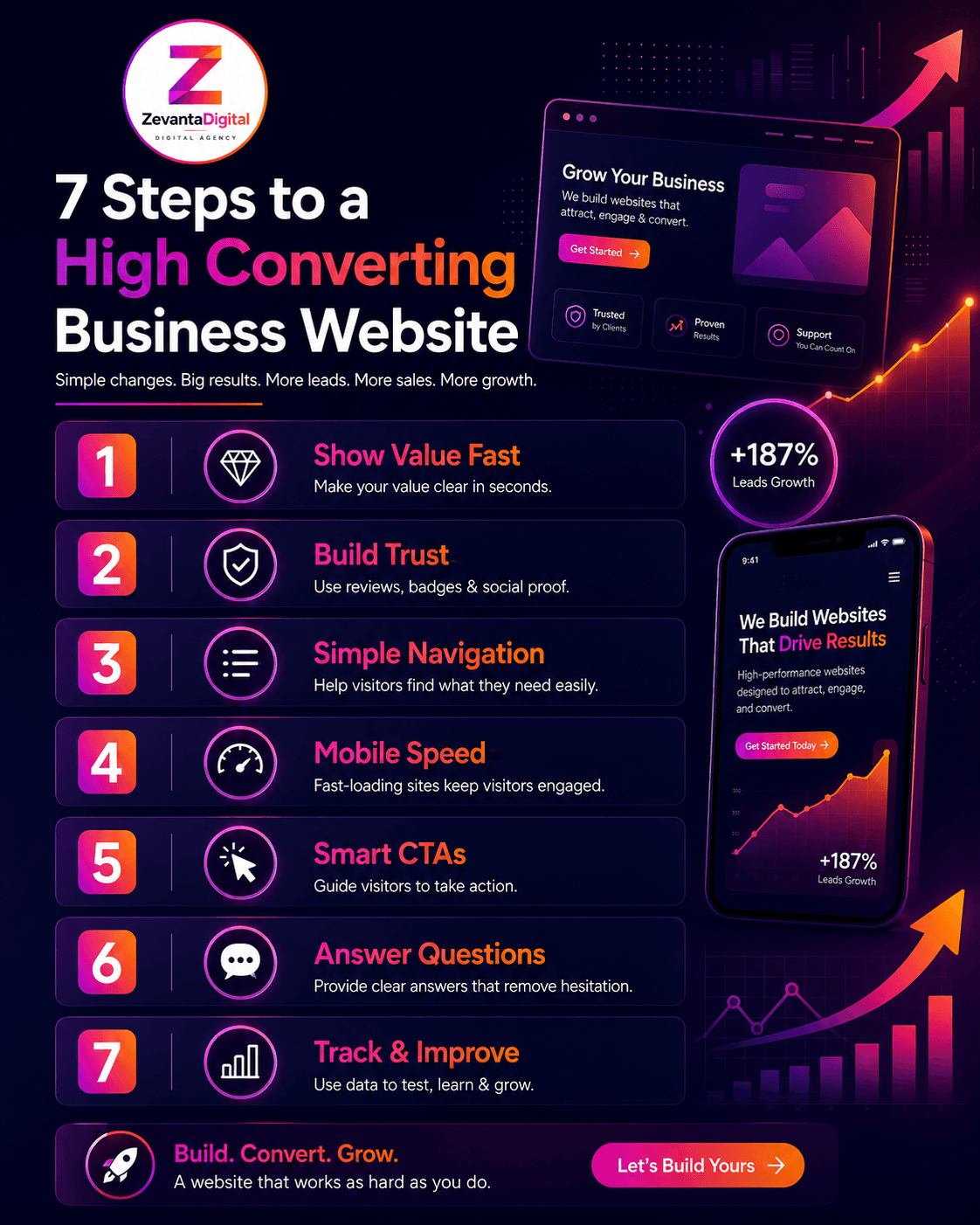
Simply put, a high-converting business website is built to guide visitors toward a useful action. For example, that action may be booking a call, filling out a form, requesting a quote, buying a product, or contacting your team. Because every business has different goals, conversion should be defined before design begins.
For a service company, the main conversion may be a consultation request. Meanwhile, a software company may want demo bookings. Similarly, an ecommerce store may want completed checkouts. Therefore, the page layout, words, visuals, and calls to action should all support the main goal.
A conversion-focused website is not pushy. Instead, it removes confusion. It answers the questions visitors already have and gives them a confident next step. This is why strategy matters before design starts.
Core Foundations of a High Converting Business Website
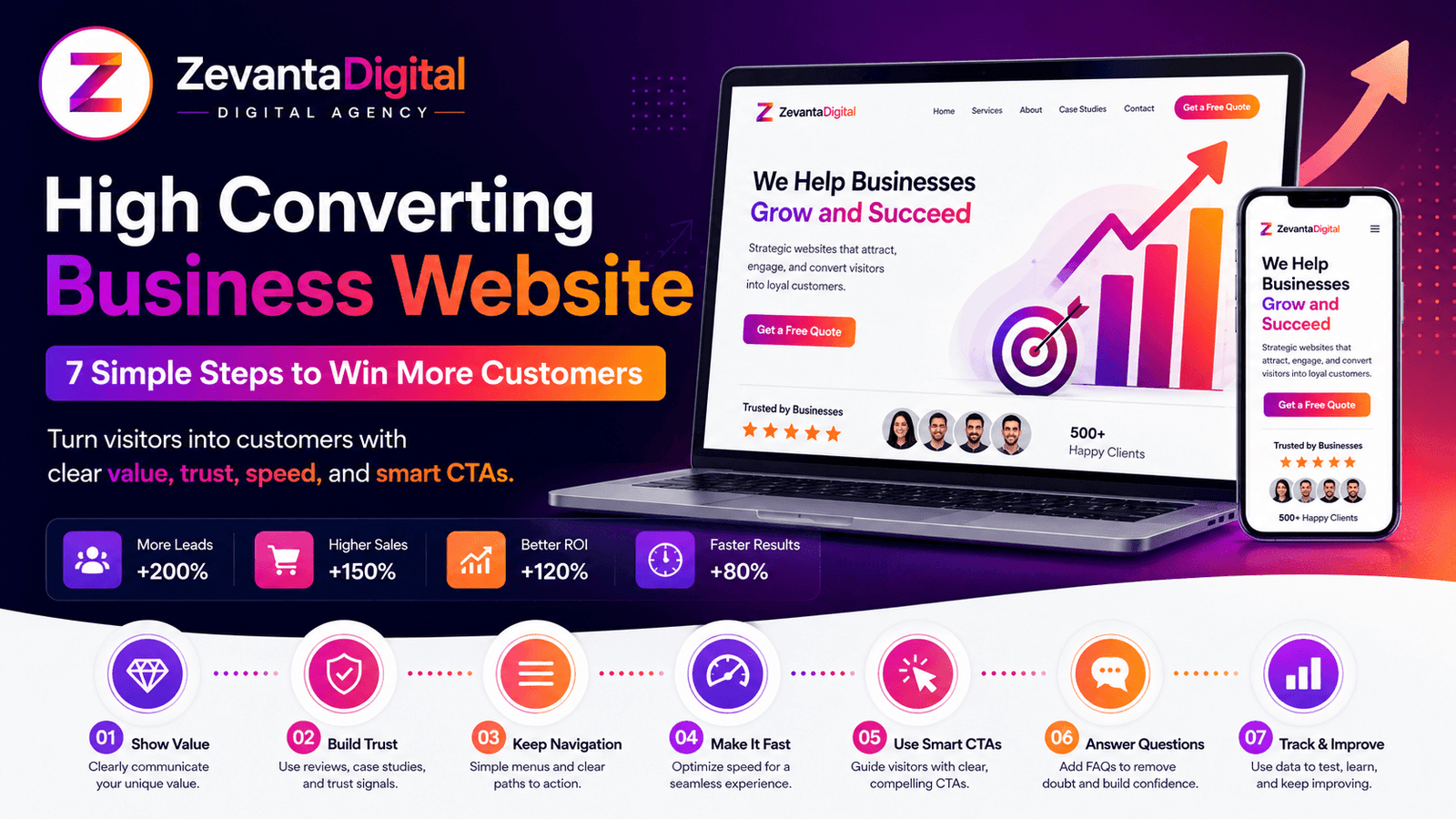
First, the foundation is clear positioning. Your hero section should explain what you do, who you help, and why the visitor should care. Simple language usually works better than clever language because people want clarity before creativity.
Next, the second foundation is user-focused structure. Most visitors scan before they read. Because of this, headings, short paragraphs, proof points, and buttons should guide the eye naturally. A strong page often moves from problem to solution, then benefits, proof, process, FAQs, and CTA.
Finally, the third foundation is persuasive copy. Good copy explains outcomes, not only features. Instead of saying modern design, explain how the design helps visitors compare services, trust the company, and request a quote faster.
Clear Message Above the Fold
The top section should answer three questions fast: what do you offer, who is it for, and what should the visitor do next? Moreover, the main button should be visible without forcing users to search.
Strong Page Flow
A good page flow feels natural. First, it names the problem. Then, it explains the solution. After that, it shows proof and process. Finally, it asks the visitor to act. This sequence reduces doubt step by step.
Mobile Design and Speed for Better Website Conversions
Mobile experience matters because many visitors browse on phones first. If sections feel squeezed, text is too small, or buttons are hard to tap, conversions can drop. Therefore, mobile design should be planned from the start.
Moreover, speed also matters. Google explains that Core Web Vitals measure loading, interactivity, and visual stability. Because of this, slow pages can hurt user experience. Learn more from Google Core Web Vitals.
To improve speed, use compressed images, clean code, caching, fewer heavy scripts, and simple animations. In addition, make sure important images have proper width and height attributes. These small technical details help pages feel stable and trustworthy.
Trust Signals That Improve Business Website Conversions
Ultimately, people convert when they believe you can solve their problem. For this reason, trust signals reduce doubt. Useful trust signals include testimonials, case studies, client logos, project results, team profiles, clear contact details, privacy policies, and transparent processes.
In addition, showing real examples of your work helps visitors imagine their own result. HubSpot shares useful conversion ideas in its conversion rate optimization guide.
Trust should appear close to decisions. For example, add testimonials near service CTAs, case studies near project claims, and security notes near forms. As a result, visitors see proof at the exact moment they may hesitate.
High-Converting Business Website vs Basic Website
| Feature | Basic Website | High-Converting Business Website |
|---|---|---|
| Goal | Online presence | Leads, sales, bookings, or inquiries |
| Messaging | Generic information | Clear value proposition |
| Design | Looks acceptable | Guides attention toward decisions |
| Mobile | May feel crowded | Built for easy action |
| Trust | Limited proof | Uses proof, results, and process |
Overall, this comparison shows why a website must do more than exist. A basic website can introduce your company. However, a high-converting website supports a measurable business goal and helps visitors move from interest to action.
Step-by-Step Guide to Build a High Converting Business Website
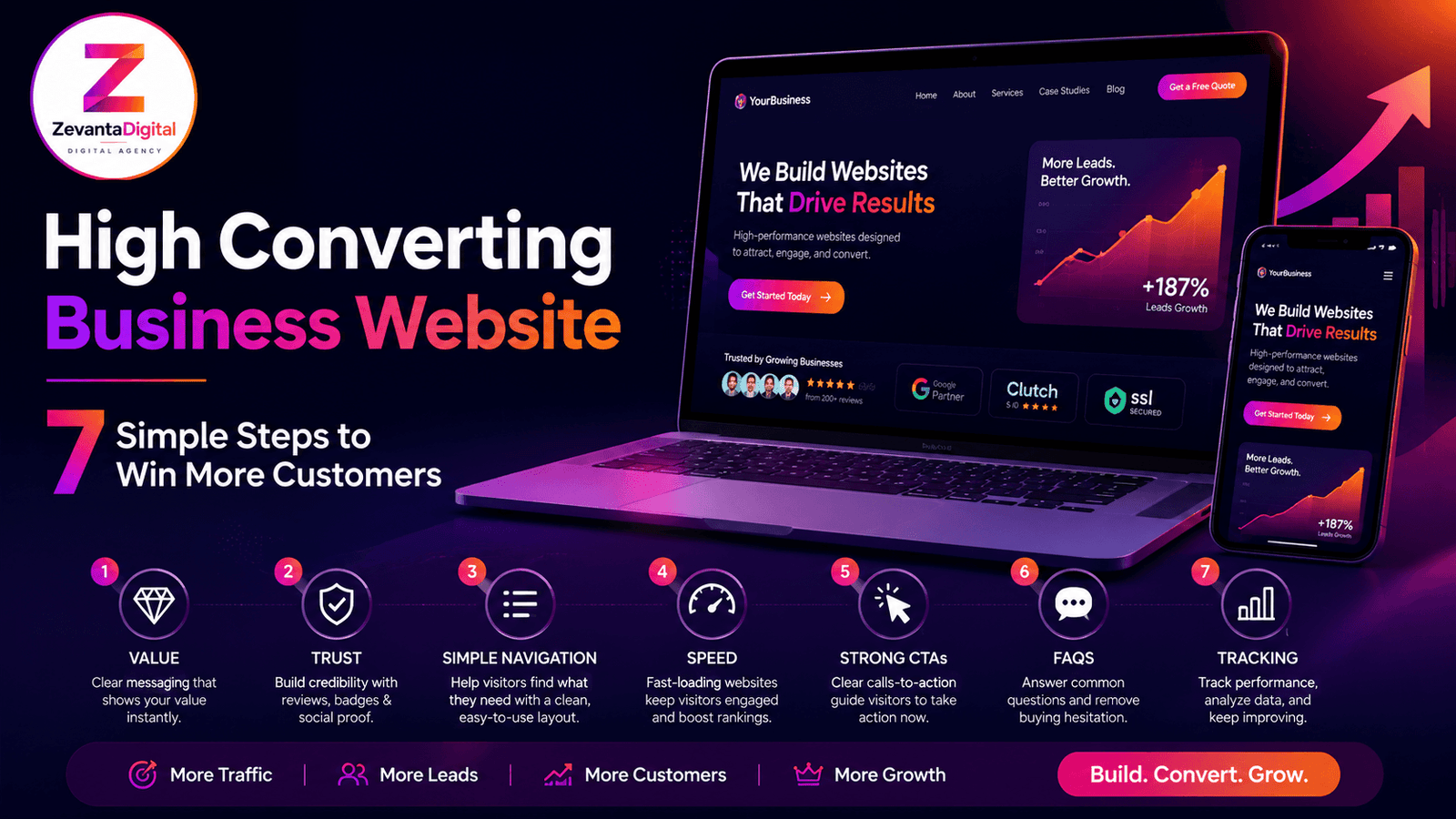
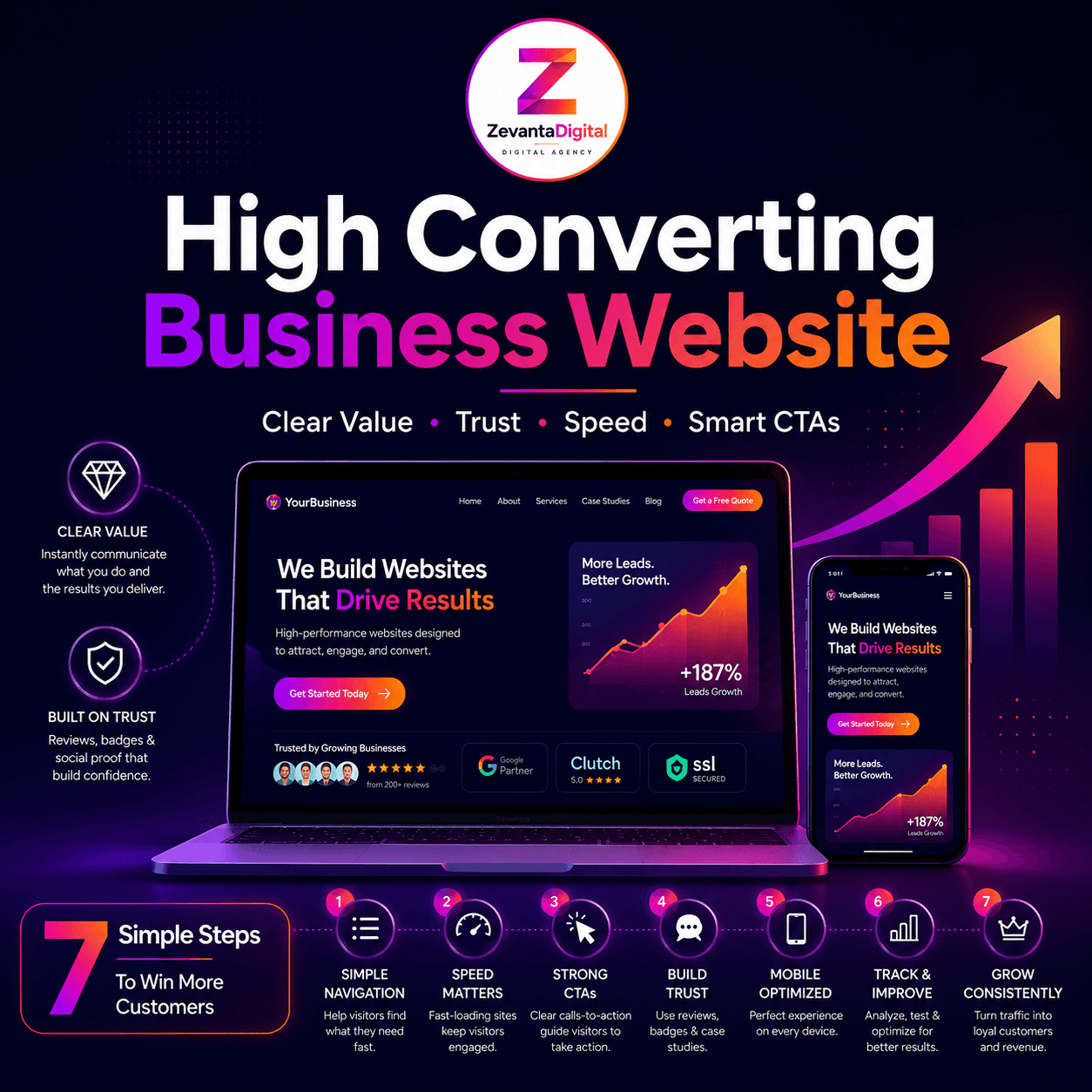
- First, define the main conversion goal.
- Next, understand your ideal audience and buyer questions.
- Then, plan the page structure around user intent.
- After that, write clear copy that explains outcomes.
- In addition, design for readability, trust, and action.
- Finally, optimize speed, SEO, tracking, and forms.
Each step should be tested before launch. For example, check whether forms work, buttons are clear, mobile spacing is comfortable, and key pages load quickly. Also, review analytics after launch so you can improve real user journeys.
Key Benefits of a High Converting Business Website
- As a result, you can get more qualified leads from existing traffic.
- Moreover, you can get better return on SEO, ads, and social campaigns.
- Also, you can build stronger trust through proof and professional presentation.
- In addition, you can create an improved mobile experience for modern users.
- Finally, you can create a clearer customer journey from first visit to inquiry.
Real-World Use Cases for Business Website Conversion
A digital agency can use a conversion-focused website to explain services, show projects, and invite visitors to book a consultation. Meanwhile, a local service business can use location pages, reviews, and quote forms to generate calls.
Similarly, a SaaS company can guide users toward demo requests or free trials. An ecommerce brand can improve product pages with stronger photos, clear benefits, reviews, and a simpler checkout path. Therefore, conversion strategy adapts to the business model.
Common Website Conversion Mistakes
Common mistakes include vague headlines, too many buttons, slow pages, weak mobile design, missing proof, long forms, and service pages that only describe features. However, these issues can often be fixed with clearer strategy and regular testing.
Another mistake is designing before writing. When copy comes later, sections often look attractive but feel empty. Instead, start with message, offer, audience, and proof. Then design the layout around those decisions.
Best Practices for High Converting Website Design
First, use one main goal per page. Next, keep paragraphs short. Then, add proof near important CTAs. Also, make forms simple. In addition, compress images. Finally, track important events. For SEO basics, review Moz Beginner Guide to SEO and the WordPress documentation.
Internal links also help users move through your site. For example, link to your services, projects, blog, and contact page where they naturally support the article.
How Zevanta Digital Helps Build High Converting Business Websites
Moreover, Zevanta Digital helps businesses plan, design, develop, and optimize websites that support real goals. As a result, our team combines UI/UX design, WordPress development, performance optimization, SEO structure, and conversion strategy to create websites that are easy to use and easy to manage.
We focus on clarity before decoration. Therefore, each page section should support the visitor journey. If your current website is not generating enough leads, a conversion review can show where users lose trust, attention, or momentum.
Frequently Asked Questions
What is a high converting business website?
In short, a high converting business website turns visitors into leads, customers, bookings, or inquiries through clear messaging, strong design, trust signals, fast performance, and effective calls to action.
Why is website conversion important?
Because of this, website conversion is important because it helps your business get more value from existing traffic and marketing spend.
What should I improve first?
For example, start with your headline, CTA, mobile layout, page speed, trust signals, and contact form.
Is WordPress good for conversion-focused websites?
Yes. However, WordPress works best for conversion-focused websites when it is built with clean design, optimized performance, strong content, and proper SEO foundations.
How long does it take to build a conversion-focused website?
Usually, the timeline depends on page count, content, custom design, integrations, and review cycles. However, a clear plan makes the process faster and more predictable.
How can Zevanta Digital help my business?
In addition, Zevanta Digital can help your business build or improve a website that supports leads, trust, speed, SEO, and customer experience.
Conclusion
A high converting business website is built with purpose. In other words, it combines clear messaging, user-focused design, fast performance, strong proof, and simple calls to action. Overall, the best website is not only the one that looks impressive. Instead, it is the one that helps your business grow.
Ready to Build Your Website?
If your website looks good but does not generate enough leads, it may need a stronger conversion strategy. Therefore, contact Zevanta Digital to discuss your next website project, request a quote, or improve your existing website for better performance and conversions.